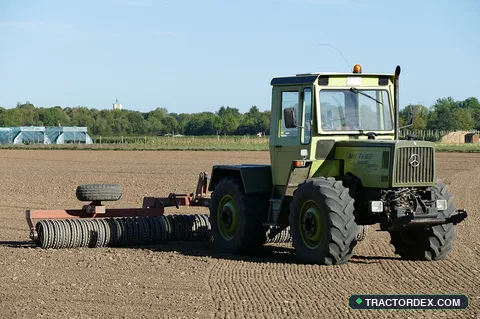
Mercedes-Benz Trac 1000
Traduction française indisponible ; contenu anglais affiché.
Années de production: 1982–1991
Sources et preuves par champ
Cette fiche importée ne contient pas encore de preuves au niveau des champs.
Ask TractorDex AI Copilot About Trac 1000
Instant technical consultation powered by heavy machinery knowledge
Engineering & Capability Benchmark
Specific output, tractive ratio, and segment percentile
Caractéristiques du moteur et de la puissance
- Modèle du moteur
- Mercedes-Benz OM366
- Carburant
- Diesel
- Puissance nominale
- 100 hp
- Rated PTO Power
- N/A (Mercedes-Benz specification)
- Cylindres
- 6
- Cylindrée
- 6 L (363.56 ci)
- Alésage / course
- 3.8386x5.2362 inches 98 x 133 mm
- Régime nominal
- 2400 RPM
- Capacité d’huile moteur
- N/A
- Capacité de liquide de refroidissement
- N/A
Maintenance picks for the Trac 1000
Filters, oil and common wear parts for this model.
Caractéristiques de transmission et de châssis
- Type de transmission
- N/A
- Rapports (avant / arrière)
- 16 avant / 8 arrière
- Système d’entraînement
- 4WD
- Empattement
- 102.36 in
- Pneu avant
- 16.9R26
- Pneu arrière
- 16.9R26
- Débit hydraulique
- N/A
- Attelage arrière
- N/A
Implement Draft & Ballast Matcher
Simulate draft resistance, drawbar power transfer, and optimal axle weight distribution for Mercedes-Benz Trac 1000.
Engine demand (99.9 HP) exceeds rated power (100 HP). Reduce working speed by 1.0-1.5 mph or reduce working width.
Instant Used Market Valuation Projector
Algorithmic resale estimate for Mercedes-Benz Trac 1000 (1982)
Direct Segment Rivals & Showdowns
Head-to-head match-ups calibrated by horsepower and era
Looking for a used Mercedes-Benz Trac 1000?
Browse live listings and auction results near you.
Comparer des machines similaires
Mercedes-Benz
Germany • 11 Models
Mercedes-Benz, a name synonymous with automotive excellence, has a rich but lesser-known history in agricultural machinery. The brand's journey into tractors began with the pioneering work of two German automotive giants: Daimler and Benz. Before their historic 1925 merger that formed Daimler-Benz AG, both companies had independently ventured into tractor manufacturing. Benz achieved a significant milestone in 1922 by producing the world's first production diesel tractor, showcasing the company's commitment to innovation and efficiency. After the merger, Mercedes-Benz continued to develop tractors until the 1930s, when the focus shifted due to economic and political factors. The brand's return to agricultural machinery came in 1950 with the acquisition of the Boeringer Unimog, a versatile four-wheel-drive vehicle equipped with a power take-off (PTO) and three-point hitch, which laid the groundwork for future developments. The 1970s marked a pivotal moment with the introduction of the MB Trac in 1973, a revolutionary four-wheel-drive tractor featuring three-point hitches at both ends, designed to offer superior versatility and performance. However, in 1980, Mercedes-Benz sold the MB Trac design to Schluter, and production ceased in 1991, signaling the end of the company's direct involvement in tractor manufacturing.
View Full Mercedes-Benz Lineup