
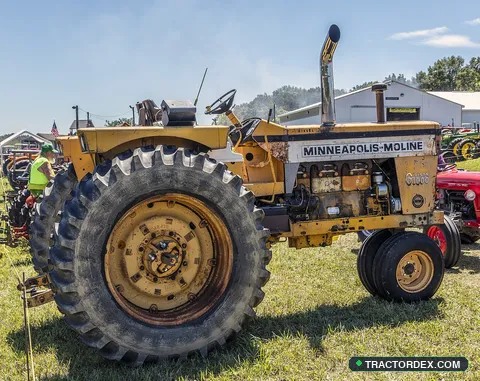
Minneapolis-Moline G1000
Traduction française indisponible ; contenu anglais affiché.
Années de production: 1965–1969 • Usine d’assemblage: Hopkins / Minneapolis, Minnesota, USA
Sources et preuves par champ
Cette fiche importée ne contient pas encore de preuves au niveau des champs.
Ask TractorDex AI Copilot About G1000
Instant technical consultation powered by heavy machinery knowledge
Engineering & Capability Benchmark
Specific output, tractive ratio, and segment percentile
Caractéristiques du moteur et de la puissance
- Modèle du moteur
- Minneapolis-Moline
- Carburant
- Gasoline
- Puissance nominale
- 100 hp
- Rated PTO Power
- 111 hp (Minneapolis-Moline specification)
- Drawbar Power @ Rated Engine Speed
- 100.99 hp (Nebraska OECD Test 2218)
- Cylindres
- 6
- Cylindrée
- 8.3 L (504 ci)
- Alésage / course
- 4.625x5.00 inches 117 x 127 mm
- Régime nominal
- 1800 RPM
- Capacité d’huile moteur
- 13 qts (~12.3 L)
- Capacité de liquide de refroidissement
- 30 qts (~28.4 L)
Maintenance picks for the G1000
Oil capacity 13 qts — match the filter before you drain.
Caractéristiques de transmission et de châssis
- Type de transmission
- Partial power shift (10F/2R)
- Rapports (avant / arrière)
- 10 avant / 2 arrière
- Système d’entraînement
- 4WD
- Empattement
- 103 in
- Pneu avant
- 10.00-16
- Pneu arrière
- 23.1-30
- Débit hydraulique
- N/A
- Attelage arrière
- II
Implement Draft & Ballast Matcher
Simulate draft resistance, drawbar power transfer, and optimal axle weight distribution for Minneapolis-Moline G1000.
Engine demand (99.9 HP) exceeds rated power (100 HP). Reduce working speed by 1.0-1.5 mph or reduce working width.
Plages de numéros de série archivées (Référence catalogue)
| Année de production | N° de série initial | N° de série final | Usine d’assemblage |
|---|---|---|---|
| 1965 | #30,500,001 | Fin de série | Hopkins / Minneapolis, Minnesota, USA |
| 1966 | #32,600,001 | Fin de série | Hopkins / Minneapolis, Minnesota, USA |
| 1967 | #34,500,011 | #34,500,290 | Hopkins / Minneapolis, Minnesota, USA |
| 1968 | #34,500,291 | #34,500,390 | Hopkins / Minneapolis, Minnesota, USA |
| 1969 | #34,500,391 | #34,500,790 | Hopkins / Minneapolis, Minnesota, USA |
| 1970 | #34,500,791 | Fin de série | Hopkins / Minneapolis, Minnesota, USA |
Instant Used Market Valuation Projector
Algorithmic resale estimate for Minneapolis-Moline G1000 (1965)
Direct Segment Rivals & Showdowns
Head-to-head match-ups calibrated by horsepower and era
Looking for a used Minneapolis-Moline G1000?
Browse live listings and auction results near you.
Comparer des machines similaires
Minneapolis-Moline
USA • 62 Models
Minneapolis-Moline was a pioneering American agricultural machinery manufacturer that emerged from the 1929 merger of three prominent companies: Minneapolis Steel and Machinery, the Minneapolis Threshing Machine Company, and the Moline Plow Company. This strategic consolidation brought together the tractor expertise of Minneapolis Steel, which had previously supplied tractors to industry giants like Case and Bull, with the established product lines of the Minneapolis Threshing Machine Company and Moline Plow Company. The resulting entity, Minneapolis-Moline, quickly established itself as an innovator in the agricultural equipment sector. One of its most notable achievements was the introduction of the UDLX Comfortractor in the late 1930s, a groundbreaking model that featured a high-speed gearbox and a fully enclosed cab equipped with a heater and radio—decades ahead of its time in terms of operator comfort and ergonomics. This commitment to innovation and operator experience set Minneapolis-Moline apart in the competitive tractor market. In 1963, the company was acquired by White Motors, a move that initially promised to strengthen its market position. However, the Minneapolis-Moline brand was ultimately phased out in 1974 as part of a broader strategic realignment by White Motors. Despite its relatively short independent existence, Minneapolis-Moline left an indelible mark on the agricultural machinery industry, particularly through its contributions to tractor design and operator comfort.
View Full Minneapolis-Moline Lineup