
Sources and field evidence
Catalog Archive: Baseline specifications compiled from historical manufacturer archives and equipment registries. Laboratory test report verification in progress.
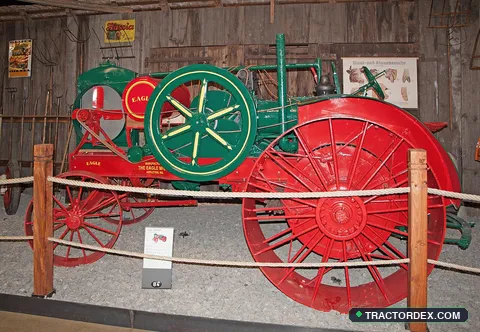
Ask TractorDex AI Copilot About H 20-40
Instant technical consultation powered by heavy machinery knowledge
Engineering & Capability Benchmark
Specific output, tractive ratio, and segment percentile
Engine and power specifications
- Engine model
- Eagle Manufacturing
- Fuel type
- Kerosene
- Rated horsepower
- 44 hp
- Rated PTO Power
- N/A (Eagle Manufacturing specification)
- Drawbar Power @ Rated Engine Speed
- 20 hp (Nebraska OECD Test 2218)
- Cylinders
- 2
- Displacement
- 16.5 L (1005 ci)
- Bore / stroke
- 8.00x10.00 inches 203 x 254 mm
- Rated RPM
- 450 RPM
- Crankcase oil capacity
- N/A
- Coolant capacity
- N/A
Maintenance picks for the H 20-40
Filters, oil and common wear parts for this model.
Transmission and chassis specifications
- Transmission type
- Gear (2F/1R)
- Gears (forward / reverse)
- 2 forward / 1 reverse
- Drive system
- 2WD
- Wheelbase
- N/A
- Front tire
- N/A
- Rear tire
- 52x18
- Hydraulic flow
- N/A
- Rear hitch
- N/A
Implement Draft & Ballast Matcher
Simulate draft resistance, drawbar power transfer, and optimal axle weight distribution for Eagle Manufacturing H 20-40.
Engine demand (83.4 HP) exceeds rated power (44 HP). Reduce working speed by 1.0-1.5 mph or reduce working width.
Tractor exceeds target ballast by 1560 kg. Consider removing wheel weights to reduce soil compaction.
Instant Used Market Valuation Projector
Algorithmic resale estimate for Eagle Manufacturing H 20-40 (1922)
Direct Segment Rivals & Showdowns
Head-to-head match-ups calibrated by horsepower and era
Looking for a used Eagle Manufacturing H 20-40?
Browse live listings and auction results near you.
Compare similar machines
Eagle Manufacturing
USA • 13 Models
Eagle Manufacturing was a pioneering American tractor manufacturer based in Appleton, Wisconsin, that operated from the early 1900s until 1938. Founded at the dawn of the agricultural mechanization era, Eagle quickly established itself as a significant player in the burgeoning tractor industry. The company initially gained recognition for its robust, large two-cylinder gasoline tractors, which were powered by engines designed and manufactured in-house. These early models were well-regarded for their power and durability, making Eagle a respected name among American farmers during the early 20th century. However, as the tractor market evolved, Eagle faced increasing competition from larger manufacturers who could produce more cost-effective machines. By 1930, the company was forced to shift its strategy, downsizing its tractors and relying on outsourced engines to reduce costs. Despite these efforts, Eagle struggled to maintain its market position. The Great Depression further exacerbated the company's challenges, leading to the cessation of tractor production in 1938. Following its exit from the tractor market, Eagle Manufacturing was acquired by the Four Wheel Drive Auto Company (FWD), which later became Seagrave Apparatus, a prominent manufacturer of fire trucks. This acquisition marked the end of Eagle's legacy in agricultural machinery, though its contributions to the early development of the American tractor industry remain noteworthy.
View Full Eagle Manufacturing Lineup